
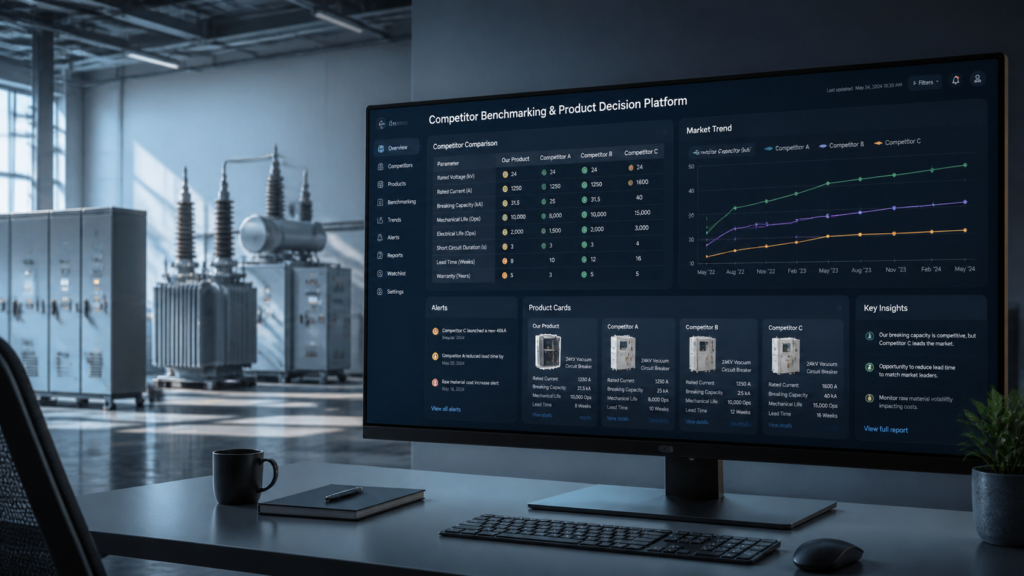
Competitor Benchmarking & Product Decision Platform

Summary

Designed and deployed a data-driven platform for real-time competitor analysis and product decision support in electrical power systems, enabling cross-functional teams at a Fortune 500 power management company to optimize specifications, pricing, and market strategy.

Actions/Responsibilities:

Product Manager

Goal:

The core challenge was integrating fragmented and heterogeneous data sources — public tenders, competitor websites, industry databases, and internal CRM/sales data — into a reliable platform within the complex electrical power systems domain (MV/LV switchgear, circuit breakers, transformers).

Additional complexity came from inconsistent competitor nomenclature, frequent specification changes, regional regulatory variation across global markets, data security and compliance requirements, and the need to serve both technical engineers and commercial users with a single interface — all while meeting the scalability, reliability, and governance standards expected in a Fortune 500 environment.

Scope:

End-to-end design and deployment of a competitive intelligence and decision-support platform — including data architecture, aggregation pipelines, dashboards, and decision-support modules (scenario modeling, side-by-side comparisons, alerting).

Strategy/Approach:

Followed a user-centric, iterative, data-first methodology beginning with deep requirements gathering across cross-functional stakeholders to define key use cases: competitor benchmarking, pricing optimization, and product specification decisions. Platform architecture was built to aggregate and normalize internal and external data in near real-time via automated scraping, APIs, and manual validation workflows. Development followed an agile framework with frequent prototyping and user testing. Strong emphasis was placed on data governance, quality controls, role-based access, and enterprise system integration. Deployment was supported by targeted training programs and success metrics tied to win rates, decision cycle speed, and product-market alignment.

Results/Outcomes:

Enabled rigorous market and regulatory benchmarking that directly shaped product roadmaps and lifecycle decisions.
Improved cross-functional team efficiency in handling technical issues and commercial positioning. Recognized by industry peers as a scalable, technically grounded solution.

Lessons Learned:

  • Strong data pipelines and cleaning processes are more critical than advanced analytics for delivering actionable insights.
  • Early involvement of all user groups and creation of tailored dashboards significantly improves adoption and business impact.
  • Near real-time updates are powerful for competitive bidding and specification decisions, but users must understand data latency and confidence levels to avoid poor decisions.
  • Decision-support features — scenario modeling, side-by-side comparisons, alerts — add substantially more value than pure reporting.
  • Transparency in data sources, validation mechanisms, and demonstrated wins are key to shifting organizational culture toward data-driven product strategy.

Start the Conversation

Kindly fill out the form below.